Why Core Vocabulary Is on the AAC Homepage (and Fringe Words Aren’t)


“If the Augmentative and Alternative Communication (AAC) device is supposed to make communication easier for my child, why aren’t their most common requests like ‘bathroom’ and ‘juice’ on the first page?”
This is a question often asked by parents and caregivers of AAC users—and it’s a good one! If our goal is ease of communication, why aren’t those things front and center? The home pages of most AAC vocabularies are based on the principles of the core word approach and motor planning.
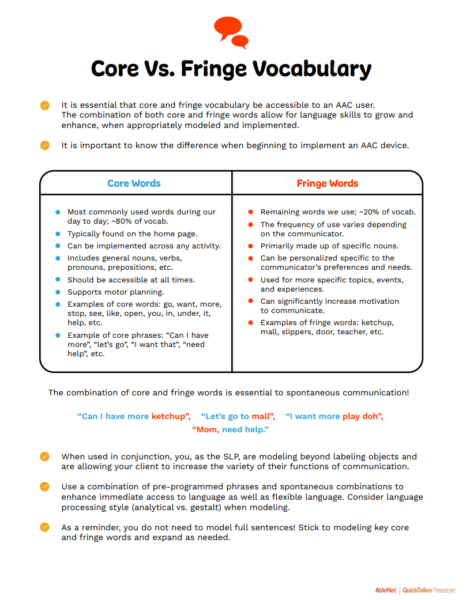
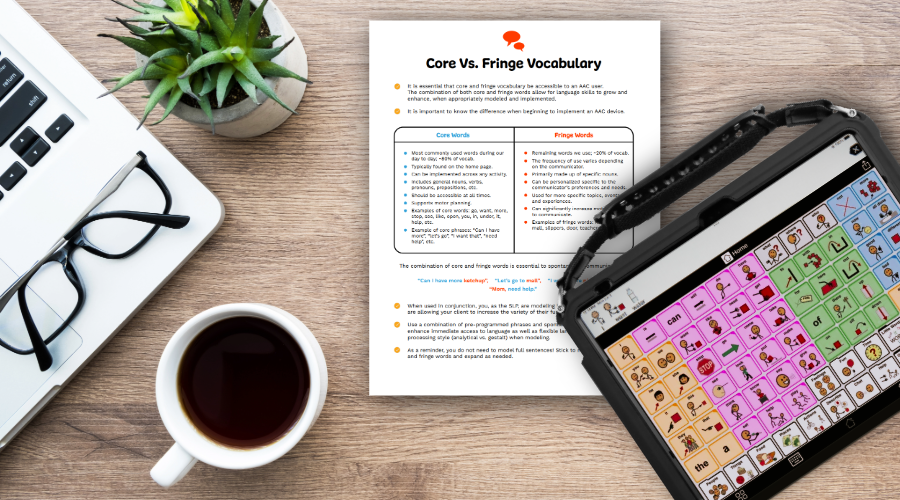
You can download a cheat sheet on core vs. fringe words at the bottom of this article!
What is the Core Word Approach?
The core vocabulary approach refers to the speech therapy method that focuses on learning core words first and then building in fringe words later.
Core Words are high frequency, flexible words that make up 75-80% of our communication. Think of words like “go,” “help,” “open,” “like,” or “want.” These are words we use all the time in a variety of contexts. These are commonly used words whose meanings can change depending on the context.
For example, we may use “go” to say:
- “Go to the bathroom”
- “Go” to start a toy
Additionally, we use “open” to say:
- “Open the package”
- “The library is open”
Fringe words, meanwhile, are what make up the other 20-25% of our vocabulary. These are words that we use only in specific situations like:
- “Diaper” when we’re talking about the bathroom
- “Pretzels” when we are talking about a snack
Why Are Core Words Important?
Since core vocabulary is used more often and in many situations, emphasizing them helps children communicate more often and with greater accuracy.
Core Vocabulary
A child who has learned the core vocabulary word of “open” can ask a caregiver to open:
- Their lunchbox
- Their pretzel package
- Their water
The word “open” allows for more communication opportunities across contexts.
Fringe Vocabulary
A child who has learned the fringe word “pretzels” can say “pretzels” but that could mean:
- Requesting pretzels
- Needing help with the pretzel package
- Labeling they have pretzels
Communication here is less clear because “pretzels” only applies to one item.
The flexibility and frequency with which we use core words is the reason they are on the home page of most AAC vocabularies! To best support our AAC users, it’s important that we leave these core words on the home page rather than removing them to make space for preferred fringe words.
When core words are front and center, children have easier access to them and more chances to practice using words that work across many situations.
Core Words and Motor Planning
Another consideration for the home page is something called the “motor plan.” Motor planning refers to the process of thinking of, initiating, and carrying out an action. With enough repetition of an action, we often no longer consciously think of the steps to carry it out.
For example, think about walking into a dark room in your house. When you first moved in, you had to feel around for the light switch, and it likely took a while to find. Now, you can walk in and find the switch instantly–without having to think about it.
The same idea applies to learning AAC. In many AAC vocabularies, the core words are in the same location on the home page as they are on any other page they may appear on. This allows for a consistent motor plan for the user. After repeated practice, they will no longer have to think about the location of icons on their device; their body knows. This means faster responses and easier communication.
Moving core words off the home page to make space for fringe words can make it harder for children, because the core words are no longer in the same place on each page. This can slow down how quickly a child learns the motor plan and, as a result, slow down their communication progress.
Modeling With Core Words
“So, if I shouldn’t move things like ‘juice,’ ‘iPad,’ or ‘bathroom,’ to the home page, what can I do to help my child get their wants and needs met?”
We can start with teaching core words and then modeling how to follow up with fringe words instead!
For example:
- Teach “eat” instead of “pretzels” to ask for a snack. “Eat” is on the home page of most AAC vocabulary, so it is accessible to our users without changing the home page layout.
- Then, model navigating to the food page where their specific snack options (like pretzels, popcorn, etc.) are to support independent choice making.
Support for Your AAC Journey
If you’re new to AAC, it can feel overwhelming to balance meeting your child’s immediate communication needs while supporting their long-term communication development. Our SLP Empowerment Team is here to help!
The SLP Empowerment team supports device users and their families through an incident-based support model. If you or your user’s SLP would like to discuss your child’s device layout and get your questions answered, you can schedule a meeting with the SLP Empowerment team.