AAC Practice Activity Ideas for Families



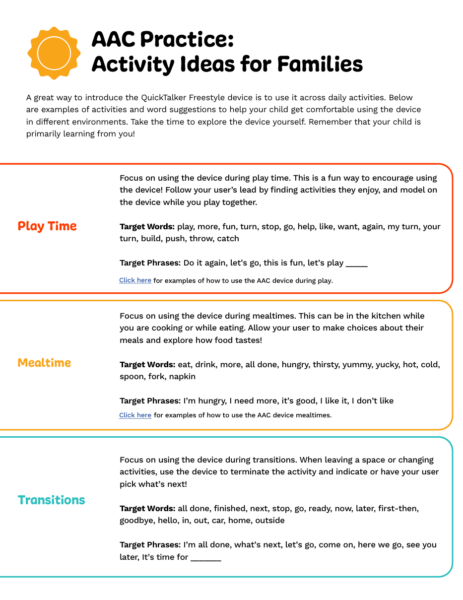
A great way to introduce the QuickTalker Freestyle device is to use it across daily activities. Below are examples of activities and word suggestions to help your child get comfortable using the device in different environments. Take the time to explore the device yourself. Remember that your child is primarily learning from you!
Read on for tips and free resource downloads!
Play Time🔗
Focus on using the device during play time. This is a fun way to encourage using the device! Follow your user’s lead by finding activities they enjoy, and model on the device while you play together.
Target Words🔗
- Play
- More
- Turn
- Stop
- Go
- Help
- Want
- Again
- My turn
- Your Turn
- Fun
- Like
- Catch
- Throw
- Push
Target Phrases🔗
- “Do it again”
- “Let’s go”
- “This is fun”
- “Let’s play _____”
Find more ways to play and use AAC with Teaching Language Using People Play Activities.
Mealtime🔗
Focus on using the device during mealtimes. This can be in the kitchen while you are cooking or while eating. Allow users to make choices about their meals and explore how food tastes!
Target Words🔗
- Eat
- Drink
- More
- All Done
- Hungry
- Thirsty
- Yummy
- Yucky
- Hot
- Cold
- Spoon
- Fork
Target Phrases🔗
- “I’m hungry”
- “I need more”
- “It’s good”
- “I like it”
- “I don’t like it”
Get more mealtime ideas with Sharing a Meal With Your Child.
Transitions🔗
Focus on using the device during transitions. When leaving a space or changing activities, use the device to terminate the activity and indicate or have your user pick what’s next!
Target Words🔗
- All done
- Finished
- Next
- Stop
- Go
- Ready
- Now
- Later
- First-then
- Goodbye
- Hello
- In
- Out
- Car
- Home
Target Phrases🔗
- “I’m all done
- “What’s next?”
- “Let’s go”
- “Come on”
- “Here we go”
- “See you later”
- “It’s time for ___”
Morning & Nighttime Routines🔗
Focus on using the device while watching TV or engaging with media. Watch videos or listen to music together and discuss the experience.
Target Words🔗
- Wake up
- Sleep
- Brush
- Wash
- Toilet
- Pajamas
- Clothes
- Shoes
- Good morning
- Goodnight
- On
- Off
Target Phrases🔗
- “Time for bed”
- “Time to get up”
- “I’m tired”
- “Let’s go to sleep”
- “Let’s wake up”
For more examples, download Incorporating AAC into Daily Routines.
Media Engagement🔗
Focus on using the device during morning and nighttime routines. Give yourself extra time to model labels, greetings, and requests in the morning and evening.
Target Words🔗
- Watch
- Listen
- Music
- Movie
- Favorite
- Loud
- Quiet
- Again
- Like
- Don’t like
- Dance
- Sing
Target Phrases🔗
- “Let’s do it again”
- “Let’s watch ____”
- “I love it”
- “This is fun”
- “It’s too loud”
- “Turn it on/off”
For fun activities, check out Incorporating AAC into Music.
Emotions🔗
Focus on using the device to discuss emotions throughout the day in a variety of settings. Label how you are feeling and model how your user is feeling.
Target Words🔗
- Happy
- Sad
- Mad
- Scared
- Tired
- Excited
- Calm
- Hurt
- Feel
- Need
- Hug
Target Phrases🔗
- “I need a break”
- “I need help”
- “I don’t feel good”
- “Can I have a hug?”
- “I’m so ______”
Download Teaching Emotions Using Speech Devices if you’d like more strategies for teaching emotions with AAC.
Social Communication🔗
Focus on using the device with others! Use the device with friends and family this week to build comfort with the device for all parties. Always ask the user’s permission before allowing someone else to touch the device.
Target Words🔗
- Hello
- Goodbye
- Friend
- Name
- My
- Your
- Share
- Play
- Together
- Tell
- Show
- Like
- Thanks
- Please
- Look
Target Phrases🔗
- “My name is ________”
- “How are you?”
- “Nice to meet you”
- “Let’s play”
- “My turn”
- “Your turn”
Bringing It All Together🔗
Bring it all together! Reflect on which parts of the day are the easiest to incorporate AAC and which ones are goals for the future. Start to build a routine of using the device in a variety of different environments!
Want more tips? Here’s 10 Tips for Supporting AAC Implementation.
Tips for Success🔗
- Before asking your child to use it, take the time to become familiar with the device yourself!
- Show how they can use the device in a lot of different situations, along with fun and motivating items and activities they like. Don’t be afraid to have some fun and be silly!
- Celebrate and acknowledge every time your child tries to communicate, trying is progress and every step counts!
- Remember, practicing regularly helps your child feel more confident communicating with the device. Consistency is key!
- Introducing AAC takes time! Remember that your child is learning WITH you; it is okay to not know it all. Remember that we are here to support you every step of the way!
Download This List🔗
You can print this whole list as a cheat sheet to remind you of what words and phrases to teach and model at different times throughout the day.
Related Links🔗