Data Collection for Progressing AAC Users



As AAC users become more fluent on the device, it can be overwhelming to narrow down which skills to target and how to collect data on them in a natural and meaningful way. Even as the user progresses, our focus continues to be on providing rich language models without the expectation of the AAC user to immediately use the skill.
As goals are developed, it is important to collaborate as a team and check in with your SLP about specific skills to progress. Here are some practical ideas to get more specific with the skills you are modeling for the user and how to take data on their spontaneous communication.
Expanding Communicative Functions🔗
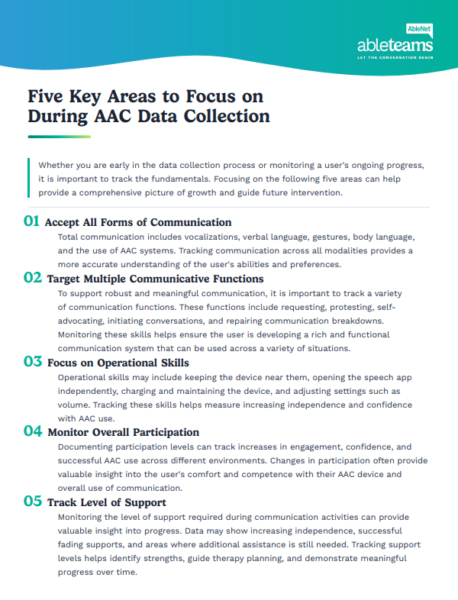
It can be easy to get stuck using an AAC device primarily for requesting, but people communicate for many different reasons, including:
- Commenting
- Expressing emotions
- Protesting
- Asking questions
- Sharing information
During a session or across a day, keep a tally of the spontaneous use of communicative functions an AAC user is expressing, and the modalities they use to communicate (e.g., AAC, gestures, speech, writing, etc.). This information can help the team to support well-rounded communication and help guide decisions about which skills and language functions may benefit from additional modeling.
Track Self-Advocacy🔗
Advocating for needs and repairing misunderstandings is an important skill. Here are a few ways to track self-advocacy.
Teams can track the frequency and independence of self-advocacy and repair behaviors. How often do they try to advocate for themselves and how frequently do they do so without prompting?
Look at specific phrases and strategies the AAC user employs to get ideas of other phrases or strategies to model. Examples of strategies may include:
- Requesting more time to respond
- Asking a communication partner to look at the device
- Indicating that a message was misunderstood
- Rephrasing a statement
- Spelling a key word
- Explaining how they communicate
This data gives a good overview of device ownership and progress towards independence.
Transferring Skills 🔗
To be a successful communicator, individuals must be able to initiate communication independently across a variety of environments and with different communication partners. We can track:
- Where initiations occur (e.g., home, school, community settings).
- Who they are directed toward (e.g., peers, family members, teachers, new communication partners).
- How they are communicated (e.g., AAC, speech, gestures, or a combination of modalities).
With this information, teams can then plan to support communication opportunities in new environments and with new communication partners.
Operational Competencies🔗
Keeping an AAC device properly running requires care and attention. It is important for AAC users to be fluent in operational competencies such as:
- Charging the device
- Adjusting the volume
- Turning the device on/off
For a full list of operational skills to target and track, check out Teaching Operational Skills for AAC Users.
Collaboration Sustains Progress🔗
As AAC users become more proficient communicators, data collection can evolve to capture meaningful growth across a variety of skills. Thoughtful data collection helps ensure that intervention remains purposeful, responsive, and focused on building the skills AAC users need to communicate effectively and independently across all aspects of daily life.
Include the other team members for your client on the data you intend on collecting. Collaboration with SLPs, families, and educators will assist AAC users in becoming more independent and confident communicators.
Need More Advice? Ask an SLP!🔗
From speech app guidance to AAC resources, our SLP Empowerment Team is here to help!