Who Can Benefit From AAC?


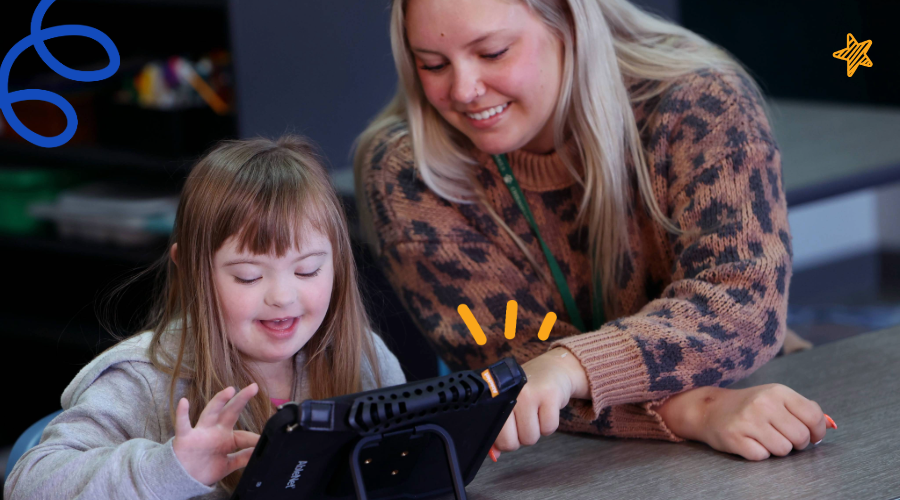
Augmentative and Alternative Communication (AAC) refers to tools that add to existing speech (augment) or offer a replacement to speech (alternative). Although it can support or replace speech, it is often only associated with individuals who are completely non-speaking. However, many people who use speech can also benefit from AAC. Because communication includes far more than spoken words, AAC can help individuals communicate more consistently, clearly, and confidently across environments.
What is Communication?
It is natural to immediately think of speech when you try to define communication. However, communication encompasses all the ways we send a message to those around us.
SLPs often refer to multimodal communication which means sending a message using many different methods. For example, communication can be in the form of speech, gestures, body language, and facial expressions. We also use technology to support our communication, such as text messages, phone calls, and emails.
We all use AAC whether we realize it or not. Have you ever waved “Hi” to a friend or passed a note in class? That is AAC!
When an individual does not have access to consistent speech, it’s important to introduce other ways to support communication; that is where AAC comes in!
Who Needs Support for Communication?
AAC should be considered as an option if speech doesn’t meet a person’s communication needs or is not consistently available. Let’s take a look at some different diagnoses and profiles and how AAC can support communication.
Some diagnoses that may benefit from AAC include developmental or genetic conditions such as:
- Autism
- Down Syndrome
- Cerebral Palsy
- Speech sound disorders
People with acquired or progressive conditions can also benefit from AAC. These include:
- Traumatic Brain Injury
- Stroke
- Rett Syndrome
While each diagnosis affects communication differently, individuals may experience challenges with speech clarity, language, motor planning (i.e. coordinating the muscles to produce speech), or memory. Some people may use speech effectively at times, but have difficulty being understood consistently, especially during periods of fatigue, stress, sensory overload, or disease progression.
How Does AAC Support Diverse Needs?
AAC can support communication across all of these diagnoses by providing an additional or alternative way to express wants, needs, thoughts, and ideas.
AAC may help by:
- Reducing frustration from communication breakdowns
- Supporting language development
- Increasing independence
- Providing more reliable access to communication throughout the day
- Supporting communication as needs change over time
For example, individuals with speech sound disorders, Down syndrome, or cerebral palsy may use AAC to clarify messages when speech is difficult to understand.
Some individuals with autism may use AAC during times when speaking is more challenging or to support expanded language learning through modeling.
Individuals with acquired disorders, such as stroke or traumatic brain injury, may use AAC to regain communication skills, while those with progressive disorders may benefit from introducing AAC early to maintain communication as skills change over time.
AAC provides another way to communicate and supports individuals in having consistent, reliable access to communication across environments and situations.
Would Your Student Benefit From AAC?
Educators play a key role in identifying students who can benefit from AAC. If you are wondering if you have a student that may benefit from AAC, talk to your SLP about it! Here are some helpful questions to discuss with the team:
- Is speech able to be understood by both familiar and unfamiliar communication partners such as special education teachers, general education teachers, peers, cafeteria staff, bus staff, etc.?
- Is the student having moments of frustration when they are not understood?
- Are they able to communicate for a variety of reasons with speech (e.g. ask questions during class, comment about what they like at lunch, tell a joke to a peer or participate in a game, etc.)?
- Can they demonstrate what they know in class by asking and answering questions or presenting information?
Introducing AAC is a dynamic process, so do not be afraid to start the conversation and ask questions!
Communication For All!
AAC is not a “last resort” or only for individuals who are completely non-speaking. It is a tool that can support communication access, reduce frustration, and help individuals express themselves more fully across environments. By recognizing the many ways people communicate, school teams can better support student participation and connection.