Supporting AAC In The Classroom: Common Challenges and Practical Solutions



AAC implementation is most successful when everyone in the classroom understands how the system works and why certain practices matter. Challenges will happen! They’re normal in any busy learning environment. However, they’re also manageable with simple, consistent strategies.
This guide outlines the most common barriers to AAC use and what staff can do to keep communication accessible, respectful, and effective throughout the day.
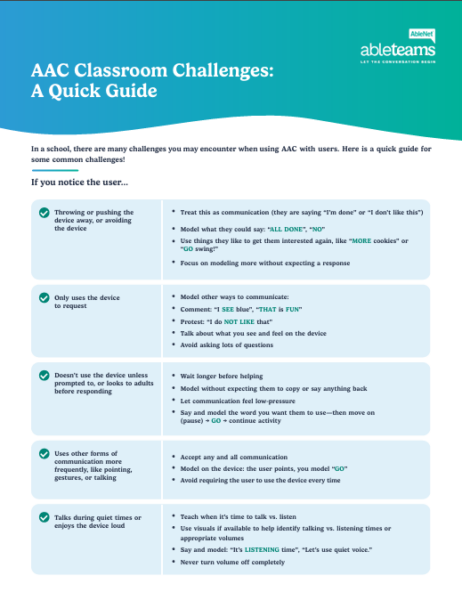
The AAC Device is Too Loud🔗
In a busy classroom, it can feel natural for staff to turn down the AAC device volume, especially if things are noisy or the device seems disruptive. However, turning down the volume actually silences the student.
What to Try🔗
- Keep volume at a minimum agreed-upon level (e.g., 60-80%).
- If the environment is loud, move to a quieter corner.
- Make volume checks part of the morning routine.
- Empower the student to adjust the volume if appropriate.
- Remind staff that AAC voices should be heard.
Why This Matters🔗
- Students need to hear language to learn it. Quiet AAC equals less learning.
- Modeling only works when it’s audible.
- If others can’t hear the student, their communication gets ignored or misunderstood.
- Volume teaches social reciprocity: students learn that communication has power and impact.
- Turning down the device is equivalent to lowering a child’s voice.
Communication Becomes a Quiz🔗
Staff may ask too many questions (“Find…”, “Tell me…”, “Where is…?”) which can create pressure and decrease communication attempts. Their intentions are good, but AAC users may get overwhelmed or feel like they’re being singled out.
What to Try🔗
- Model language through comments rather than questions.
- Instead of “What do you want to eat?” try “I’m getting hungry. I want crackers.”
- Give the student time to respond (10 seconds or more).
- Celebrate any communication attempt (gesture, vocalization, AAC).
- Aim for 80% comments and 20% questions. Conversation should be natural, not a quiz.
Why This Matters🔗
- Testing disrupts natural communication.
- Students may avoid AAC when they feel pressured.
- Quizzing limits meaningful language use.
- It shifts communication from connection to correctness.
My Student Forgot Their Device🔗
Students can be forgetful. They might forget their books, their pencils, their lunch, or their AAC device! This presents a communication barrier for the user.
What to Try🔗
- Use a verbal cue like, “Before we go, check for your device.”
- Assign a staff “AAC Buddy” per period who makes sure the device moves with the student (not carrying it for them, just ensuring it comes along).
- Use straps, mounts, or a small shoulder bag to make carrying easier.
- Add visual reminders on the door: “Got your voice?”
- Practice device-carrying as part of independence building, just like putting on a backpack.
- Have Lite-Tech backups available for users or Core Board posters in common areas throughout the school.
Why This Matters🔗
- Without AAC, students lose access to expressing needs or asking for help.
- By making the device routine, it becomes an important part of the user’s day.
- Lite-Tech backups ensure that the user never feels left out of a conversation.
Staff Can’t Find Words on the Device🔗
Sometimes staff want to model a specific word but struggle to locate it, which leads to frustration or giving up.
What to Try🔗
- Focus on core vocabulary: Words like “go,” “want,” “help,” “stop,” “more,” and “look.”
- Model part of a sentence instead of the whole.
- Example: Instead of trying to find “rectangle” in a science lesson, model “look” or “this.”
- If you can’t find a word within a few seconds, move on. Keep modeling something.
- Ask an SLP or AAC team to show you where that tricky word lives later—not in the middle of a lesson.
- Use “general” words for most interactions, and save specific words for supported teaching moments.
Why This Matters🔗
- Prevent staff overwhelm by focusing on words on the homepage.
- Make modeling natural for everyone!
- Keeping AAC interactions positive promotes better connection with the device!
The Student Isn’t Using the Device🔗
Staff may think the AAC isn’t helpful because the student isn’t initiating often or they’re not using it with intention.
What to Try🔗
- Increase modeling and reduce pressure.
- Look for small signs of engagement: looking at the device, touching one word, or repeating a model.
- Use motivating, meaningful activities—AAC thrives in fun.
Why This Matters🔗
- AAC learning requires ongoing exposure before independence develops.
- Without consistent modeling, students have fewer chances to learn.
- IRemember: AAC learning is like learning a new language.
The Device Isn’t Accessible🔗
Devices may be left in backpacks or in desks. Sometimes they come in with depleted batteries, or when they’re charging are out of reach.
What to Try🔗
- Keep AAC with the student, not stored away.
- Charge the device consistently at the same time daily.
- Have a charging location for the device that allows users to continue to use the device while it charges.
- Provide a low-tech backup communication board that mirrors the device layout.
- Use mounts, stands, or consistent placement strategies.
Why This Matters🔗
- Students lose access to communication during important moments.
- Inaccessibility signals that AAC is optional rather than essential.
- Missed moments slow language development.
Classroom Checklist🔗
- Is the device available and accessible at all times?
- Is the volume loud enough to hear across the room?
- Are staff modeling throughout the day?
- Does vocabulary support full communication, not just choices?
- Is AAC used in every environment?
- Is communication supportive rather than testing? Are we avoiding quiz-style interactions?
- Is there a backup available?
Friendly Reminders For Staff🔗
- Turning down the volume limits the student’s opportunity to learn and communicate.
- AAC should travel everywhere communication is expected.
- Modeling should feel natural—not like a test or a search mission.
- Mistakes are okay.
- Every moment in the classroom is a chance to support communication growth.
Together, We Succeed🔗
AAC works best when it is always accessible, audible, and supported through natural, low-pressure communication. Staff should keep device volume up, model frequently using simple core words, avoid turning conversations into quizzes, and ensure the device travels with the student throughout the day. Even if a student isn’t using AAC independently yet, consistent exposure and modeling build the foundation for future communication. With small routines and shared expectations, every classroom moment becomes an opportunity to support meaningful language growth.
Need More Advice? Ask an SLP!🔗
From speech app guidance to AAC resources, our SLP Empowerment Team is here to help!