Honoring Autonomy: Cueing Strategies to Use



As AAC is introduced, teams may discuss different strategies to teach using the device. In the excitement of wanting to see our communicators be successful, it can be tempting to use hand over hand support. While this type of support may be used to teach other skills, there are some drawbacks to using it when introducing AAC and teaching language. Here are the reasons teams should not use hand-over-hand support when introducing AAC and what to try instead.
Why To Not Use Hand-Over-Hand?
- Reduces autonomy and authentic communication – Hand-over-hand prompting can unintentionally lead to guiding an AAC user’s communication rather than allowing them to express what they truly want to say.
- Prompt Dependency – The AAC user may become overly reliant on the communication partner, decreasing their ability to use the device independently.
- Inhibits learning and exploration – It reduces opportunities for the AAC user to explore the AAC device independently, which is crucial for learning language.
- Discomfort or frustration – Physical prompting can be intrusive for the AAC user, especially if they have different sensory processing needs. It may also lead to frustration if they feel they are not in control of the communication process.
What Should We Try Instead?
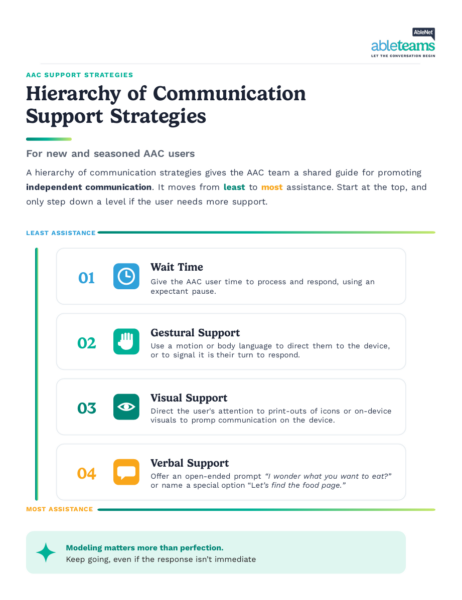
Our first step in promoting authentic, independent communication is modeling. Some users may benefit from additional support in the following ways:
- Wait Time: Get comfortable leaving pauses, 30 seconds or more, for the AAC user to respond or initiate! It is okay if they do not respond at that time, just move on to another support strategy and continue to model.
- Gestural Support: Simply pointing to an icon on the screen or to the device in general can be a low-pressure way to encourage the AAC user to communicate with the device and support them in finding the word they want.
- Visual Support: Charts or print outs of icons, or even picture reminders to have the device present can be helpful as environmental cues to encourage spontaneous communication. These supports can be placed near the device for easy reference.
- Verbal Support: Offer verbal guidance to help the user navigate the device. This can include instructions on which buttons to press or reminders about the available vocabulary. For example, you might say, “I wonder what you want for snack, let’s check out the food folder!”

Other Strategies to Support Independent Communication
Customized Vocabulary: Talk with your SLP about programming motivating items or activities within a robust vocabulary program! Personalization can help AAC users talk about their favorite topics and increase self-prompted engagement.
Make the device accessible: Create routines to ensure the device is always charged and ready for use so AAC can be modeled around the clock.
External Supports
For users who may have difficulty accessing the device via direct selection (i.e. selecting icons with a finger), talk with your SLP about trying a keyguard or alternative access methods to support independent communication access.
Empowered and Independent
When introducing AAC, our goal is to support independent communication while respecting the autonomy of the communicator. Although hand-over-hand prompting may seem helpful in the moment, it can limit exploration, increase prompt dependency, and reduce opportunities for meaningful language learning. By using supportive strategies such as modeling, wait time, verbal, visual or gestural supports, and personalized AAC systems, teams can create a more empowering communication environment that encourages confidence, participation, and long-term success.
Need More Advice? Ask an SLP!
From speech app guidance to AAC resources, our SLP Empowerment Team is here to help!