QuickTalker Freestyle Speech Evaluation FAQ


Completing a comprehensive speech evaluation is a critical step in securing funding approval for the QuickTalker Freestyle. This FAQ addresses the most common questions our Speech-Language Pathologists encounter during the evaluation and documentation process.
Our Speech Evaluation Team can be reached at [email protected] or (651) 362-2850. Please don’t hesitate to reach out!
You can download this as a PDF if you wish to keep it: QuickTalker Freestyle Speech Evaluation FAQ
If there is no trial required by the insurance company, do I still need to rule out two alternative methods of AAC in the evaluation?
Yes! The insurance company wants to see that alternative systems/communication methods have been ruled out to further justify the need for the QuickTalker Freestyle.
Some insurance providers have specific requirements for what needs to be ruled out, so please reference the insurance requirements you receive at the start of the ableEXPERIENCE process as a guide for what to include in your speech evaluation.
The insurance company requires devices to be considered or trialed and ruled out. What is the difference?
Considered: Devices/communication methods you have considered are those you haven’t physically trialed, but instead safely ruled out through clinical judgement.
Trialed: Devices/communication methods you have trialed are those you have used in sessions and are able to rule out via data/observation.
Can someone at AbleNet review my speech evaluation before I sign and finalize the report?
Yes! All speech evaluations submitted to AbleNet are reviewed by an analyst on our team prior to moving forward in the funding process. If edits or additional information are needed, we will reach out to you with recommendations via email.
If using AbleNet’s online tool to complete your speech evaluation, signing and submitting the report is a required step prior to our review of your speech evaluation. In the event updates or changes are needed, we will provide a link that will prompt you to re-sign the speech eval when the changes have been made.
What AAC systems are considered low/mid/high-tech?
- Low-tech:
- Anything without electronics/batteries is considered low-tech.
This may include a coreboard, picture exchange system, communication book/
board, or other visuals. You may also discuss American Sign Language as a
low-tech form of AAC.
- Anything without electronics/batteries is considered low-tech.
- Mid-tech:
- Systems with auditory feedback/speech output, but without a dynamic display and extensive vocabulary, are considered mid-tech. Examples of mid-tech devices include the BigMack switch and QuickTalker Feather Touch.
- High-tech:
- Systems with dynamic display and extensive vocabulary. For the purposes of insurance, Speech Applications can also be considered as high-tech methods.
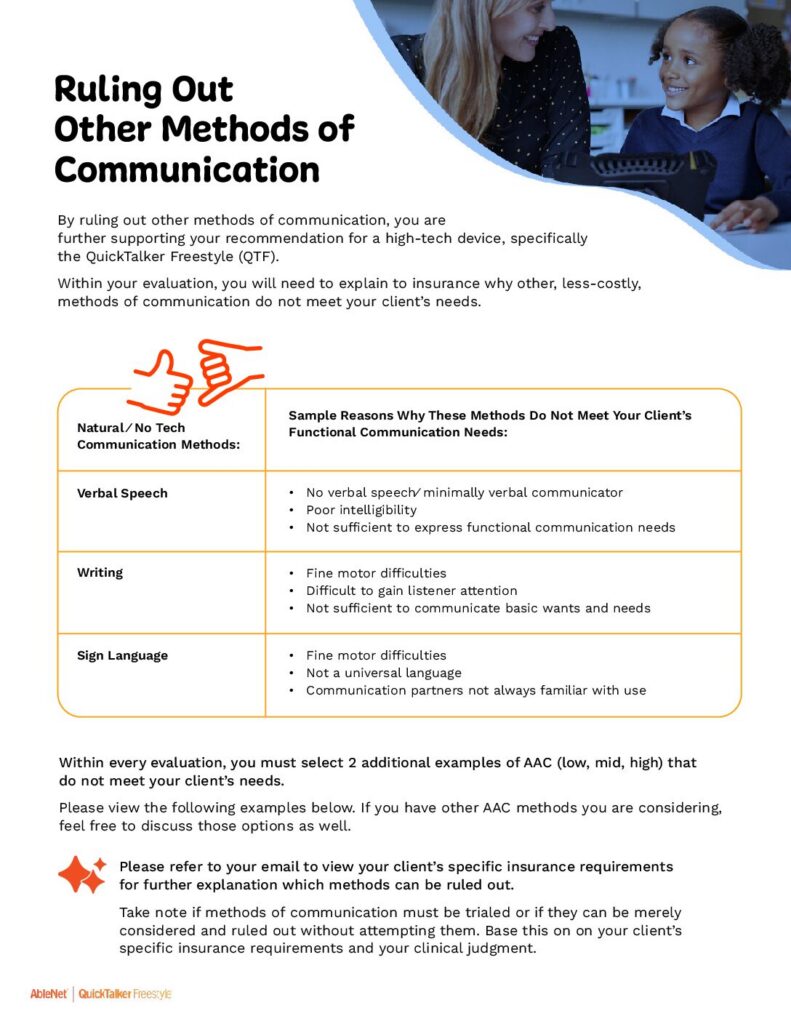
Click here for a resource further outlining ruling out other methods of communication.
I don’t have specific information on my client’s hearing/vision status, or any recent screening results, but they appear to be Within Normal Limits (WNL). What should I do?
Unless specifically required by the insurance company, you do not need to include results of a vision or audiological screening/formal evaluation.
I have completed my evaluation. Where is my link to upload an evaluation?
Each funding request includes a unique link to upload and save speech evaluation documents. Please check your email or your SLP portal for this link, or contact our Funding Services team if you need additional support!
Save this for later🔗