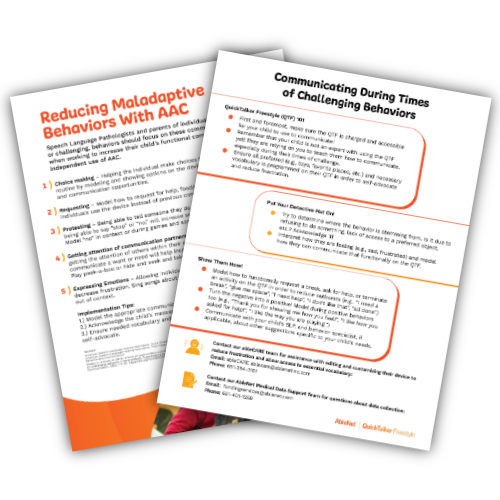
When Challenging Behavior is Communication: Parent’s Guide




Last Updated: September 1, 2026
We’ve all been there: one second you and your loved one are having a great time, and then suddenly something doesn’t go the way they expect. They become frustrated and react in a way that is challenging: crying, throwing things, refusing to participate.
It makes sense for you to want to focus on stopping the behavior, but there is another way to look at challenging behavior form AAC users.
“What are they telling me?” 🔗
For people who use AAC, challenging behavior can be the result of not being able to communicate what they want, need, feel, or don’t like. Looking for the message behind the behavior can help us figure out what communication skills we can teach and practice on their QuickTalker Freestyle.
Begin By Asking Why🔗
Not every behavior is communication, so determining why its happening is a great place to start. When a challenging moment happens, take a breath, and think about what happened right before it.
Ask yourself:
- Did they not want to do something?
- Could they not get to something they wanted?
- Were they told “no,” or that they couldn’t have something?
- Were they tired, overwhelmed, frustrated, or having a hard time?
- Did something change unexpectedly?
Validate Their Feelings🔗
Once you know the “why,” acknowledge how they might be feeling.
Try saying things like:
- “You’re frustrated.”
- “You really wanted that.”
- “You don’t want to do that.”
Their feelings are real, even when they’re expressing them in a way that’s hard for us to understand.
Redirect Them🔗
Now, show them another way they can communicate that message using their QuickTalker Freestyle. This way you’re not just trying to stop the behavior, you’re giving them another way to be heard.
Communication Skills to Practice🔗
Once you notice what your loved one is trying to communicate, look for opportunities to practice those messages when everyone is calm.
Making Choices🔗
Choices give AAC users a way to have a say in what happens next. Offer simple choices throughout the day and model the options on their device.
- For example, you might ask “Do you want the RED cup or BLUE cup?” while pressing RED and BLUE on the device.
- Give them time to make a choice.
- Celebrate all communication attempts even if they aren’t perfectly formed responses!
- If they choose another choice, acknowledge what they said and re-state that these are the choices.
- If they don’t use the device, and point to a cup instead, continue to model on the device, “Good choice! Let’s use the BLUE cup today.”
Sometimes having a little control can make a big difference.
Making Requests🔗
We ask for things all day long. Our loved ones need those same opportunities!
Model simple, useful requests like:
- “Help”
- “More”
- “Drink”
- “Open”
- “I want ___”
Use everyday routines to practice these words so your loved one gets lots of chances to use them. And when they communicate? Respond! That connection between “I said something” and “someone listened” is so important.
Saying “No” and “Stop” 🔗
This one is huge.
Our loved ones need a way to tell us when they don’t want something, when something hurts, or when they’ve had enough.
Model words and phrases like:
- “No”
- “Stop”
- “All done”
- “I don’t like that”
- “Not yet”
And when your child protests, honor that. AAC isn’t just about helping our kids ask for things. It’s also about giving them a voice to say what they don’t want.
Getting Someone’s Attention🔗
Sometimes your child just wants to say, “Hey! Look at this!” Give them plenty of opportunities to get your attention and start an interaction.
Try:
- Taking turns calling for each other on the device.
- Going for a walk and using “look” when you see something interesting.
- Playing games that involve taking turns.
- Modeling words like “look,” “come,” “watch,” or “my turn.”
Communication is also about connecting with the people and the world around us.
Talking About Feelings🔗
Big feelings can be hard to communicate, especially when you’re already overwhelmed. Help your child learn the words for those feelings by modeling them during everyday moments.
You might say while modeling:
- “I’m HAPPY!”
- “You look FRUSTRATED.”
- “That made you SAD.”
- “Wow! You’re EXCITED!”
Books, songs, play, and everyday life are all great opportunities to practice emotions.
And remember: you don’t have to wait for a meltdown to talk about feelings. Practice these words when your child is calm so they’re easier to find when they really need them.
Tips That Make a Big Difference🔗
AAC works best when it’s available and part of everyday life and not something we pull out only when our child needs to “use their words.”
A few things to keep in mind:
- Keep the device available – Make sure the QuickTalker Freestyle is charged and within reach. And if you know your child’s device is likely to run out of battery, have a backup plan ready.
- Make sure the words they need are there – Think about the words your child uses most often, along with words they might need to advocate for themselves, ask for help, protest, or express feelings.
- Model, model, model – You don’t have to wait for your child to use the device first. Show them how you would use it during real-life situations.
- Respond to communication attempts – Every attempt matters. If your child points, touches a word, gestures, vocalizes, or uses their device, look for the message they’re trying to share and respond to it.
You Don’t Have to Figure It Out Alone🔗
Helping your child build communication skills is a team effort. Parents, caregivers, educators, SLPs, and everyone else supporting your child can help create an environment where communication is encouraged throughout the day.
The goal isn’t to make every challenging behavior disappear. The goal is to help your child have more ways to communicate what they need, want, feel, and think. When our kids have a way to say “help,” “no,” “more,” “I’m mad,” “look!” or “I’m all done,” they have more opportunities to be understood.
And honestly? Being heard can change everything.