Finding Their Voice: AAC Representation in Modern Media



Last Updated: July 21, 2026
Think back to your childhood. What characters from books, TV shows, or movies did you feel strongly connected to? Did they look like you? Did they have similar experiences?
You thought something like “Wow, this person is like me. I can relate to them and what they’re going through.” You felt validated and seen, even inspired to be more like them.
These moments are important for everyone, regardless of their race, gender, background, or disability. It is no different for Augmentative and Alternative Communication (AAC) users. Seeing someone communicate like they do can remind them that their voice belongs in every story.
While authentic AAC representation in the media is still rare, several prominent movies, TV shows, documentaries, and books feature memorable people and characters who use AAC to communicate with the world.
Here are a few examples for AAC users of all ages!
For Kids🔗
Aidan in A Day With No Words (2023 Children’s Book)
Written by autistic author Tiffany Hammond, this children’s picture book follows an autistic mother and her non-verbal autistic son through an ordinary day. Aidan uses a tablet-based speech-generating device to communicate his wants, needs, and ideas. The story shows AAC as a natural part of family life rather than something that needs to be fixed or overcome.
Julia in Sesame Street (1969-Present TV Show)
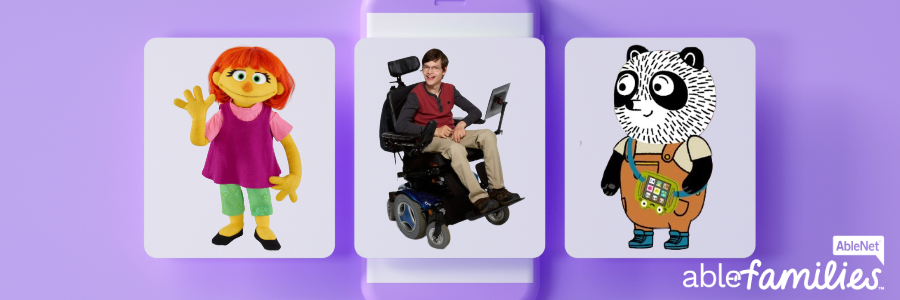
Julia is a bright and curious four-year-old autistic character from Sesame Street. She communicates in diverse ways depending on the situation, including speech, gestures, actions, and, in some stories and resources, an AAC device. Her character helps young viewers understand that there is more than one valid way to communicate and participate. Rated TV-Y. Watch full episodes on PBSkids.org!
Paolo in Carl the Collector (2025–Present TV Show)
Paolo is an adorable young panda introduced in the wonderfully inclusive PBS KIDS animated series Carl the Collector. He is an autistic, nonspeaking character voiced by Odin Frost, a real-life non-verbal autistic teenager who also uses AAC. That authentic casting makes Paolo’s inclusion especially meaningful. Rated TV-Y. Watch full episodes on PBSkids.org!
For Tweens & Teens🔗
Melody Brooks in Out of My Mind (2024 Movie)
This Disney+ feature film, based on the popular middle-grade novel by Sharon M. Draper, follows Melody Brooks, a brilliant, non-speaking sixth-grade student with cerebral palsy. People often underestimate Melody, but gaining access to a speech-generating device allows her to share the intelligence, humor, and personality that were always there. (Movie rated PG | Novel grades 5-8)
J.J DiMeo in Speechless (2016–2019 TV Show)
In this groundbreaking sitcom, J.J. is the oldest, sharp-witted, nonspeaking son in a chaotic family of five. He primarily uses a low-tech laser pointer attached to his glasses to point to letters, words, and phrases on a communication board attached to his wheelchair. An aide reads his selections aloud. The series allows J.J. to be more than his disability. He is funny, sarcastic, confident, and fully involved in his family’s chaos. He is 16 years old, and he has teenage experiences with his supportive family. Rated TV-PG.
Renee in Loop (2020 Animated Short)
Renee is a nonverbal autistic teenager featured in the Pixar animated short Loop. While on a canoeing trip, she communicates through vocalizations, gestures, body language, and images on her phone. Her partner must learn to slow down, pay attention, and understand the ways she communicates. Renee is voiced by Madison Bandy, who is also autistic and non-verbal. Rated G.
For Adults🔗
Steve Gleason in Gleason (2016 Documentary)
This documentary follows former NFL player Steve Gleason after he is diagnosed with ALS. As the condition affects his ability to move and speak, he begins using eye-tracking technology and a speech-generating device to communicate. The film follows his changing communication needs, family life, and advocacy for people living with ALS. Rated R for language.
Jean-Dominique Bauby in The Diving Bell and the Butterfly (2007 Movie)
This French biographical film is based on the life of Jean-Dominique Bauby, editor-in-chief of French Elle magazine, and his 1997 memoir The Diving Bell and the Butterfly. After experiencing a massive stroke and developing locked-in syndrome, Jean-Dominique Bauby is unable to move or speak, except for blinking one eye. In the film, another person reads through a specially arranged alphabet, and Bauby blinks when they reach the letter he wants. Using this lite-tech AAC system, he communicates with the people around him and dictates an entire memoir one letter at a time. Rated PG-13.
DJ Savarese in Deej (2017 Documentary)
This Peabody Award-winning documentary follows DJ “Deej” Savarese, a nonspeaking autistic college student who communicates using a text-to-voice synthesizer. Instead of having other people tell his story for him, DJ shares his own experiences through his words, poetry, and narration. Recommended for grades 9 and up. Check out their where to watch page.
Stephen Hawking in The Theory of Everything (2014 Movie)
This dramatized biographical film follows the life of physicist Stephen Hawking, including the progression of ALS and its effect on his movement and speech. The movie also shows Hawking using his computerized speech-generating system, which became one of the most recognizable examples of AAC in modern history. Rated PG-13.
Representation Is a Great Start🔗
Seeing AAC in movies, television shows, documentaries, and books is a great start, but there is still progress to be made. AAC users should not appear only when a story wants to teach a lesson about disability. They deserve to be the hero, the funny best friend, the class clown, the troublemaker, or the main character.
For our loved ones, seeing an AAC device on screen or in a book can make something that feels different look ordinary, and sends a simple but powerful message:
People who communicate differently still have stories worth telling, jokes worth hearing, ideas worth sharing, and voices that belong everywhere.