Reducing Challenging Behaviors With AAC



Challenging behaviors are often misunderstood, but they’re usually a form of communication. When AAC users don’t have the tools to express their needs, wants, or emotions, behavior becomes their voice.
Speech-language pathologists and parents of individuals with maladaptive or challenging behaviors should focus on these communication functions when working to increase their child’s functional communication and independent use of AAC.
In the Moment, Start With “Why” 🔗
When a challenging behavior occurs, we often ask, “How do we stop this behavior?” A more effective question is: “What is this person trying to communicate?” When we teach AAC users how to communicate more effectively, we reduce frustration and open the door to greater independence and connection.
Start by figuring out why the user is behaving this way. What triggered this behavior to begin with?
For example:
- Does the user not want to do something?
- Was the user told they were not allowed to do something?
- Is the user unable to access a preferred object?
Then, interpret and acknowledge how they must be feeling (e.g. sad, frustrated, or angry). These feelings are real to the user. Reflect the emotions back to them to show you understand. Then show them how they can communicate this on the QuickTalker Freestyle.
Functional Communication Skills to Support🔗
Once you determine the “Why” behind a challenging behavior, you can then take steps to reduce the behavior in the future. Use the functional communication strategies below to empower AAC users and reduce frustration.
Choice Making🔗
Helping the individual make choices throughout their daily routine by modeling and showing options on the device to increase independence and communication opportunities.
- Offer structured choices during routines
- Model selecting options on the AAC device
- Reinforce all attempts at communication
Requesting🔗
Model how to ask for help, food/drink, and favored activities so AAC users communicate through the device instead of previous communication strategies.
- Model requests for common needs (e.g., “help,” “more,” “drink”)
- Use consistent routines to encourage repetition
- Respond immediately to reinforce successful communication
Protesting🔗
Being able to tell someone they do not like do not like something, or being able to say “stop” or “no,” will increase self- autonomy and independence.
- Model “no” in context or during games and songs
- Respect and acknowledge the protest
- Model “I don’t like that” or “all done” to stop an activity
Gaining Attention🔗
Engaging in social interactions and getting the attention of others when they need to communicate a want or need will help increase functional social communication.
- Play hide and seek and take turns calling each other on the device
- Take a walk to the park and point out interesting things by pushing “look” on the device
- Practice turn-taking activities using the QuickTalker Freestyle
Expressing Emotions🔗
Allowing individuals to tell us how they are feeling will decrease frustration. When they can label and share their emotions, AAC users can build stronger relationships and learn emotional regulation.
- Label emotions as they happen (e.g. “I’m so happy!” “That dinosaur is angry!”)
- Use songs, stories, and visuals to teach feelings
- Validate and respond to communicated emotions
Implementation Tips🔗
Building skills and reducing challenging behaviors with AAC is most effective with consistency and practice.
- Ensure device access: make sure the QuickTalker Freestyle is charged and available when it’s needed! Make sure there’s a back up if you need it.
- Make vocabulary available: program preferred and core vocabulary on the QuickTalker Freestyle so that users can self-advocate.
- Model consistently: demonstrate using the speech app and device in real-life situations.
- Acknowledge communication attempts: respond meaningfully whenever the individual uses the AAC system (e.g. “I like how you asked for help!” “Wow, that’s a tall tower!”).
A Collaborative Approach🔗
Supporting communication is not just the responsibility of SLPs. Families, caregivers, and educators all contribute to creating communication-rich environments where individuals feel heard and understood.
When everyone works together to model, encourage, and respond to communication, individuals gain the tools they need to replace challenging behaviors with meaningful expression.
Share these Strategies🔗
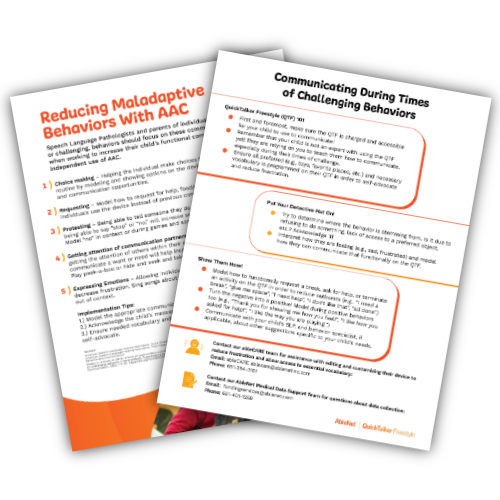
Want to provide these tips and tricks to other team members? Download and print the handouts!
Was this article helpful?
0 of 0 found this helpful