AAC Core Words Calendar


Sometimes, the most difficult part of modeling Augmentative and Alternative Communication (AAC) is deciding which words to work on. That’s where a structured plan can be very helpful for the whole AAC team.
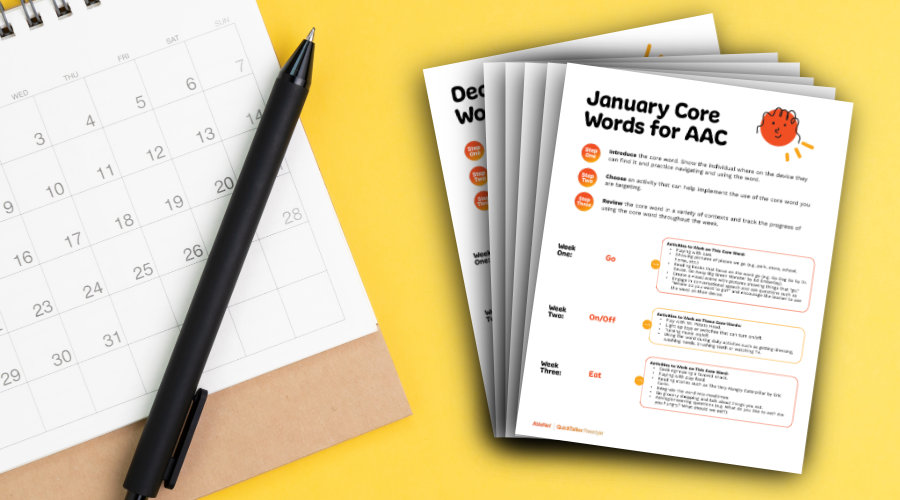
This AAC Core Words Calendar offers a month-by-month guide for introducing high-frequency core words and embedding them into everyday activities. By focusing on a small set of words each month, communication partners can create repeated opportunities for language learning in natural settings.
Scroll all the way down and download the complete PDF to share with caregivers, SLPs, teachers, and everyone on the team!
Why Year-Round Core Word Practice Matters🔗
Core vocabulary forms the foundation of functional communication. Unlike topic-specific vocabulary, core words can be used across settings, partners, and activities.
Consistent practice supports:
- Language development through repeated exposure and use
- Increased independence during daily routines
- Greater participation at home, school, and in the community
- Improved self-advocacy and social interactions
- More flexible communication across many situations
When communication partners model core words naturally throughout the day, AAC users learn that these words have real purpose and value.
Monthly AAC Core Word Focus Areas🔗
Here’s your month-to-month practice! You can either use this structured plan on its own, or tweak it to fit your user’s needs.
For each month, you’ll use the same process:
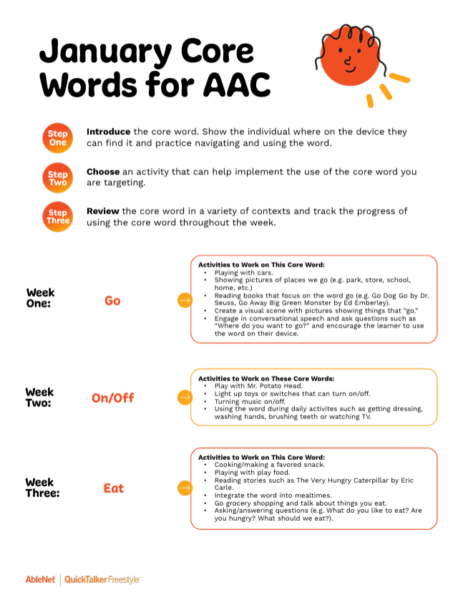
- Introduce the core word. Show the individual where they can find it on the device and practice navigating and using the word.
- Choose an activity that can help implement the use of the core word you are targeting
- Review the core word in a variety of contexts and track the progress of using the core word throughout the week.
January: Building Early Communication
Week 1: Go
- Playing with cars.
- Showing pictures of places we go (e.g. park, store, school, home, etc.)
- Reading books that focus on the word go (e.g. Go Dog Go by Dr. Seuss, Go Away Big Green Monster by Ed Emberley).
- Create a visual scene with pictures showing things that “go.”
- Engage in conversational speech and ask questions such as “Where do you want to go?” and encourage the learner to use the word on their device.
Week 2: On/Off
- Play with Mr. Potato Head — Put his hat on and take his shoes off.
- Light up toys or switches that can turn on/off.
- Play Freeze Dance — Turn the music on and off.
- Using the word during daily activities such as getting dressing, washing hands, brushing teeth or watching TV.
Week 3: Eat
- Cooking/making a favorite snack.
- Playing with play food.
- Reading stories such as The Very Hungry Caterpillar by Eric Carle.
- Integrate the word into mealtimes.
- Go grocery shopping and talk about things you eat.
- Asking/answering questions (e.g. What do you like to eat? Are you hungry? What should we eat?).
Week 4: Want
- Requesting favorite toys or food.
- Choice making.
- Go on a scavenger hunt and talk about the items we “want” to find.
- Throughout daily routines, talk about what you “want” to do or who “wants” to do certain activities.
- Coloring or Play-Doh. Have them request things they want while playing.
February: Expanding Requests and Participation
Week 1: I/Me
- Start creating phrases that incorporate “I want” during daily routines.
- Play a “Who Has What?” game. Learners can respond with “me!” and then expand to “I have it.”
- Play an action game where learners say “I can jump,” “I can clap,” or “I can twirl.”
- During turn-taking games, ask who wants a turn and encourage responses using “I” or “me.”
Week 2: More
- Request more during music activities.
- Ask for more while coloring.
- Use during snack time.
- Practice while using play dough.
- Request more during pretend kitchen play.
- Use during videos, swinging, and outdoor activities.
Week 3: Help
- Request help while playing on the playground.
- Use during academic tasks.
- Ask for help while getting dressed.
- Request help during snacks and meals.
- Ask for help when completing puzzles or sorting activities.
- Use during gross motor activities such as riding a bike, climbing, or swinging.
Week 4: Stop
- Play with toys that move or make sounds and model the word when they stop.
- Practice on the swing and request “stop.”
- Go on a walk and stop to find scavenger hunt items.
- Stop videos or music and have the learner request “more” or “go” to continue.
- Use “stop” and “all done” to help learners advocate for themselves during activities.
March: Describing Actions and Preferences
Week 1: Open/Close
- Open and close toy containers, books, doors, and windows.
- Sing Wheels on the Bus using open and close hand motions.
- Play with toys that have lids, doors, or compartments.
- Request items to open and close during arts and crafts.
Week 2: Like
- Talk about favorite foods and toys.
- Ask if the learner likes different activities.
- Read a favorite book and discuss what characters or items they like.
- Use “I like” during play and conversation.
Week 3: Make
- Make a favorite snack together.
- Play with bubbles and talk about what you can make.
- Create play dough shapes and creations.
- Use pretend food and discuss what you will make to eat.
Week 4: Mine/My
- Play matching games.
- Use toy cars and take turns identifying whose turn it is.
- Practice ownership during snack time.
- Use bubbles, board games, and crafts to reinforce “mine” and “my.”
- Work on these words during turn-taking activities throughout the day.
April: Understanding Concepts and Social Language
Week 1: Over/Under
- Create an obstacle course and give directions using “over” and “under” (e.g., go under the table, over the pillow).
- Hide objects around the room and give clues using location words.
- Take turns giving directions to each other.
- Label objects that are over or under other objects throughout the day.
Week 2: Big/Small
- Use play dough to make big and small creations.
- Build big and small towers with blocks.
- Compare toys, books, foods, or household items by size.
- Practice stretching your body to be big and curling into a ball to be small.
- Take turns choosing whether everyone should be “big” or “small.”
Week 3: Yes/No
- Play a thumbs up/thumbs down game while answering questions.
- Use memory matching cards and determine if two pictures are the same.
- Answer yes/no questions during story time.
- Complete puzzles and determine whether pieces fit.
- Use yes and no during daily choices and routines.
Week 4: Hello/Goodbye
- Sing greeting songs that include “hello” and “goodbye.”
- Practice greetings during arrival and dismissal.
- Take a walk around school or the clinic and greet peers and adults.
- Use hello and goodbye during transitions between activities.
- Model greetings during play and social interactions.
May: Expanding Actions and Observation
Week 1: Play
- Use musical instruments and encourage the learner to “play” music.
- Play sports or physical games using the word “play.”
- Create pretend play scenarios such as a kitchen or doctor’s office.
- Use educational games on a tablet or computer.
- Discuss what everyone wants to play during free time.
Week 2: Up/Down
- Blow bubbles and watch them go up and down.
- Build block towers up and knock them down.
- Raise and lower your arms while labeling up and down.
- Turn volume up and down while listening to music.
- Play movement games such as Simon Says or Hokey Pokey.
Week 3: Now
- Use “now” to signal when an activity begins.
- Practice opening and closing toys “now.”
- Use arts and crafts materials and discuss what you are doing now.
- Talk about what is happening now during games and routines.
- Model phrases such as “eat now,” “play now,” and “go now.”
Week 4: Look/See
- Go on a nature walk and look at things outside.
- Play “I Spy” games using look and see.
- Read books with detailed pictures and discuss what you see.
- Create a scavenger hunt and look for hidden objects.
- Take turns directing others to look at interesting items.
June: Summer-Themed Communication
Week 1: Water/Swim
- Match pictures of summer activities with the words water and swim.
- Play at a water table or splash in a small pool.
- Read books about swimming and summer.
- Use toy animals or dolls that can swim.
- Talk about places where people swim.
Week 2: Drink
- Play beach ball toss and identify the core word.
- Create a pretend lemonade stand.
- Talk about favorite summer drinks.
- Practice requesting a drink during snack time.
- Label different beverages throughout the day.
Week 3: Hot/Cold
- Read summer-themed stories and label hot and cold items.
- Compare warm and cold objects safely.
- Sort pictures into hot and cold categories.
- Talk about hot weather and cold treats.
- Use water, ice, and sunshine examples to reinforce the concepts.
Week 4: Fun
- Role-play favorite summer activities.
- Spend time outdoors and discuss what is fun.
- Choose fun games and activities together.
- Talk about fun places to visit during summer.
- Model phrases such as “fun outside” and “that is fun.”
July: Opinions and Flexible Thinking
Week 1: Good/Bad
- Taste test foods and decide if they are good or bad.
- Talk about the weather and describe it as good or bad.
- Look at safety pictures and decide if actions are good or bad.
- Discuss favorite and non-favorite activities.
- Describe story characters and choices.
Week 2: It
- Play guessing games using household objects or toys.
- Describe what a toy is doing using the word “it.”
- Read books and identify objects as “it.”
- Create art projects and refer to materials using “it.”
- Label objects in the environment using simple sentences.
Week 3: Think
- Play mystery bag guessing games.
- Listen to sounds and guess what they are.
- Try taste tests and guess flavors.
- Look for hidden pictures in books.
- Use phrases such as “I think…” throughout activities.
Week 4: Again
- Request to play favorite games again.
- Sing repetitive songs and ask for them again.
- Open and close toys again.
- Repeat favorite actions during movement activities.
- Ask for arts and crafts materials again when needed.
August: Social Interaction and Sharing Ideas
Week 1: Turn
- Practice turn-taking during board games.
- Talk about whose turn it is throughout the day.
- Use toys that turn on and off.
- Turn puzzle pieces or gears while playing.
- Practice saying “my turn” and “your turn.”
Week 2: Love
- Create a collage of things you love.
- Use AAC to label favorite people, foods, and activities.
- Play love-themed bingo games.
- Read books about family and friendship.
- Discuss things everyone loves.
Week 3: You
- Play “Who Do You See?” using pictures.
- Create stories using the word “you.”
- Play peek-a-boo and say “I see you.”
- Practice social interactions using “you.”
- Ask questions that encourage responses using “you.”
Week 4: Say
- Play “I Say” or Simon Says.
- Practice following verbal directions.
- Use AAC to repeat simple phrases.
- Play “What Does the Animal Say?”
- Take turns giving instructions to others.
September: Reasoning and Direction Concepts
Week 1: Why/Because
- Ask and answer simple why questions.
- Discuss daily choices and preferences.
- Create silly cause-and-effect scenarios.
- Talk about classroom decisions.
- Model responses using “because.”
Week 2: Fast/Slow
- Run and walk at different speeds.
- Jump fast and slow.
- Listen to music and describe it as fast or slow.
- Watch videos at different speeds.
- Race toy cars and compare speeds.
Week 3: Need
- Request needed items during snack time.
- Use “I need help” during challenging tasks.
- Practice asking for supplies during crafts.
- Identify what is needed for daily routines.
- Use the word throughout academic and play activities.
Week 4: Near/Far/Through
- Complete a treasure hunt with location clues.
- Throw bean bags near and far targets.
- Go through tunnels or obstacle courses.
- Describe where objects are located.
- Practice giving and following directions.
October: Questions, Emotions, and Time Concepts
Week 1: Happy/Sad
- Complete a daily feelings check-in.
- Practice making happy and sad faces.
- Read books and identify character emotions.
- Talk about things that make you happy or sad.
- Use AAC to label emotions throughout the day.
Week 2: What/Where
- Ask and answer “what” questions around the room.
- Play touch-and-guess games with hidden items.
- Play hide-and-seek and ask “where?”
- Read books and ask questions about pictures.
- Practice requesting information using what and where.
Week 3: Morning/Afternoon/Night
- Sort activities by time of day.
- Practice greetings based on the time of day.
- Label morning, afternoon, and night routines.
- Look at clocks and discuss time concepts.
- Discuss activities that happen during each part of the day.
Week 4: Can/Can’t
- Talk about classroom or home rules.
- Identify actions you can and can’t do.
- Look at pictures and discuss allowed activities.
- Volunteer for simple jobs by saying “I can.”
- Practice making choices using can and can’t.
November: Demonstratives and Social Exchange
Week 1: This/That
- Play two-choice games using preferred items.
- Ask the learner to identify this versus that.
- Complete scavenger hunts using location cues.
- Point to nearby and distant objects.
- Take turns giving directions with this and that.
Week 2: Do/Don’t
- Use songs with action directions.
- Play a modified Simon Says game.
- Discuss safe and unsafe choices.
- Sort pictures into do and don’t categories.
- Practice following multi-step directions.
Week 3: Here/There
- Play hide-and-seek with favorite toys.
- Toss a ball back and forth and label where it is.
- Choose whether to sit here or there.
- Describe the location of objects.
- Use here and there during daily routines.
Week 4: Give/Take
- Practice sharing toys.
- Play pretend store activities.
- Pass objects around a circle.
- Follow directions such as “give me” and “take it.”
- Use the words during snack and play activities.
December: Comparing, Transitioning, and Quantities
Week 1: Different/Same
- Play matching games and puzzles.
- Sort objects by whether they are the same or different.
- Compare colors, shapes, and sizes.
- Read books and find matching pictures.
- Use the words during everyday observations.
Week 2: Put
- Practice cleaning up toys.
- Put objects into containers.
- Follow directions about where to put items.
- Play silly games putting things in unusual places.
- Take turns giving directions using the word put.
Week 3: To
- Talk about where you are going throughout the day.
- Travel to different locations around the building.
- Practice transition phrases such as “to speech” or “to home.”
- Use maps or pictures to discuss destinations.
- Give directions using the word to.
Week 4: All/Some
- Offer some or all of a preferred snack.
- Play with toys that have multiple pieces.
- Sort objects into all and some groups.
- Discuss whether all or some items are being used.
- Model the words throughout meals, play, and clean-up activities.
Supporting Communication All Year Long🔗
A year-long core word plan helps create consistent and meaningful communication opportunities across environments. By focusing on core vocabulary that can be used every day, AAC users gain tools to support language growth, independence, participation, and connection with others.
Print This Guide!🔗
Share this 12-month plan with other members of the team by accessing the PDF below.
Need More Advice? Ask an SLP!🔗
From speech app guidance to AAC resources, our SLP Empowerment Team is here to help!