AAC Book Companion Resources


Reading books with AAC users creates natural opportunities for language learning, shared attention, and meaningful communication. This collection of AAC book companion activities includes ideas for snacks, sensory play, crafts, movement activities, and teletherapy sessions.
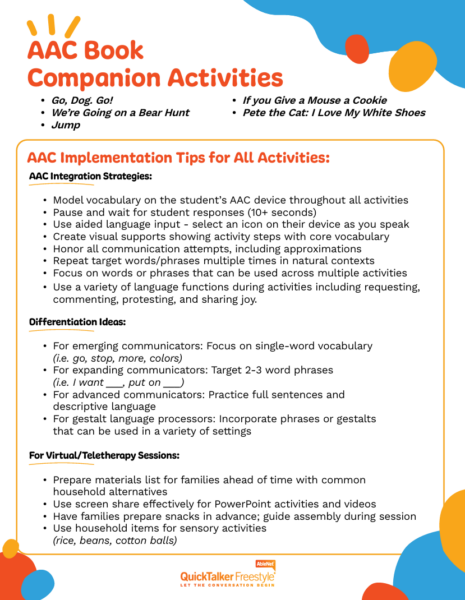
AAC Implementation Tips🔗
Use these tips and tricks for all of the activities!
Integration Strategies🔗
- Model vocabulary on the user’s AAC device.
- Pause and wait for user responses (10+ seconds).
- Use aided language input – select an icon on their device as you speak.
- Honor all communication attempts, including approximations.
- Repeat target words/phrases multiple times in natural contexts.
- Focus on core words or phrases that can be used across multiple activities.
- Use a variety of language functions during activities including requesting, commenting, protesting, sharing joy.
Differentiation Ideas🔗
- For emerging communicators: Focus on single-word vocabulary.
- (i.e. go, stop, more, colors)
- For expanding communicators: Target 2-3 word phrases.
- (i.e. I want, put on ____)
- For advanced communicators: Practice full sentences and descriptive language.
- For gestalt language processors: Incorporate phrases or gestalts that can be used in a variety of settings.
For Virtual/Teletherapy Sessions🔗
- Prepare materials list for families ahead of time with common household alternatives.
- Use screen share effectively for PowerPoint activities and videos.
- Use household items for sensory activities.
- (i.e. rice, beans, cotton balls)
Activities for Go, Dog. Go!🔗
Author: P.D. Eastmen
Theme/Focus: Opposites, prepositions, colors and core words
Target Vocabulary (Core Words & Phrases)
- Core Words: go, stop, up, down, in, out, on, off, fast, slow
- Phrases: “Go, dog, go!”, “Stop, dog, stop!”, “Dogs on top”, “Look at them/Look at those dogs go” “Let’s go in/up/down” “I like it/I do not like it”
Snack Activity: No-Mix Puppy Chow 🔗
Make this tasty snack together and use AAC to discuss the steps, the taste, and more!
Ingredients
- Chex cereal or Golden Grahams
- Mini marshmallows
- M&Ms or chocolate chips
- Powdered sugar
Directions
- Pour cereal into individual bowls or cups
- Add marshmallows and M&Ms to mix
- Sprinkle powdered sugar on top
- Mix together with a spoon
- Enjoy your puppy chow snack!
Target Vocabulary: mix, put in, more, stop, all done, yummy, sweet
Sensory Activity: Red Light, Green Light🔗
Play the classic movement game Red Light, Green Light, connecting it to the “go” and “stop” concepts from the book.
Materials
- Red and green construction paper circles (optional)
- Open space for movement
Directions
- Designate one person as the “stoplight.”
- When the stoplight says “green light” or “go,” players move forward.
- When the stoplight says “yellow light,” players move forward slowly.
- When the stoplight says “red light” or “stop,” players must freeze.
- Continue until players reach the finish line.
Target Vocabulary: go, stop, fast, slow, walk, run, ready, wait
Craft Activity: Dog Party Hats🔗
Create festive dog party hats inspired by the party scene in the book.
Materials
- Construction paper (various colors)
- Tape or stapler
- Markers, crayons, stickers
- Pom poms, glitter (optional)
- Elastic string or ribbon
Directions
- Roll construction paper into a cone shape
- Tape or staple to secure
- Decorate with markers, stickers, and other materials
- Attach elastic string to secure under chin
- Wear your party hat!
Target Vocabulary: roll, make, put on, my turn, colors/ shapes, pretty, wear
Teletherapy Activities🔗
Activity 1: Dog vs. Cat Brain Break
Watch this Dog vs. Cats themed Brain Break video from Coach Brenda Becker and complete the activity below!
Directions
- Watch the video together.
- Follow along with the movements when dogs or cats appear.
- Pause to practice core vocabulary during the video.
Target Vocabulary: dog, cat, go, stop, jump, move, again, more
Activity 2: Would You Rather – Dog Edition
Watch this dog-themed Would You Rather video from Mr. Hassel’s Brain Breaks and play a this or that game with AAC!
Directions
- Watch video and discuss “Would you rather” questions about dogs.
- Student indicates preference using AAC device.
- Practice explaining choices with simple phrases.
Target Vocabulary: I want, like, don’t like, yes, no, dog, play, eat
Activities for We’re Going on a Bear Hunt🔗
Author: Michael Rosen | Illustrated by Helen Oxenbury
Theme/Focus: Prepositions, locations, descriptive language, and sequencing
Snack Activity: Bear Caves🔗
Use graham crackers and Teddy Graham’s to create a delicious camping scene!
Ingredients
- Graham crackers (2-3 per cave)
- Frosting, Nutella, or peanut butter
- Teddy Graham crackers
Directions
- Take two graham crackers.
- Spread frosting along one edge of each cracker.
- Stand crackers up and lean together to create tent/cave shape.
- Place teddy graham inside, outside, or next to the cave.
- Practice positional vocabulary while eating.
Target Vocabulary: in, out, next to, on top, above, under, inside, outside, bear, cave
Sensory Activity 1: Bear Hunt Sensory Bin🔗
Create a winter/forest sensory bin that represents the different environments from the story.
Materials
- Large plastic bin or container
- Cotton balls or white pom poms (for snow)
- Small pine cones
- Small plastic pine trees
- Play people or small dolls
- Small toy bears
- Blue fabric or paper (for river)
- Green paper strips (for grass)
Directions
- Set up story scenes in the sensory bin.
- Engage in sensory exploration while labeling items on device.
- Target pretend play by picking a scene from the story and act it out with the sensory bin.
- Practice positional words by putting items in, over, or under.
- Explore new textures with sensory play.
Target Vocabulary: grass, river, mud, snow, forest, cave, cold, wet, sticky, through, over, under
Sensory Activity 2: Nature Walk Bear Hunt🔗
Go on a nature hunt around the school or neighborhood!
Materials
- Bag for collecting items
- Binoculars (real or complete the craft activity)
- Camera or device for taking photos
Directions
- Go outside for a nature walk.
- Look for items from the story.
- (grass, trees, mud, water, animals)
- Label items found in the environment
- Take photos on the device or collect nature items.
- (leaves, sticks, rocks)
- Discuss what you found when you return.
Target Vocabulary: tree, grass, rock, stick, leaf, bird, animal, see, look, find, nature, outside
Craft Activity: Binoculars🔗
Make a pair of binoculars to search for bears, just like a real bear hunt!
Materials
- 2 toilet paper tubes per student
- Yarn or string
- Tape or glue
- Markers, crayons, stickers
- Hole punch
Directions
- Decorate both toilet paper rolls with markers and stickers.
- Glue or tape the two rolls together side by side.
- Punch holes on the outer sides of each roll.
- Thread yarn through holes and tie to create neck strap.
- Use binoculars to “look for bears” around the room, go on a nature walk, or play I-Spy during teletherapy.
Target Vocabulary: look, see, where, find, bear, colors (for decorating), make, my, put
Teletherapy Activities🔗
Activity 1: Bear Hunt Movement Video
Follow along with this bear hunt video from the Kiboomers for a movement break!
Materials
- Device to play video
- Open space for movement
Directions
- Watch the video together.
- Follow along with stomping, jumping, running movements.
- Practice loud and quiet voices during repetitive phrases.
- Pause to practice vocabulary on AAC device.
Target Vocabulary: stomp, jump, run, quiet, loud, fast, slow, going, stop
Activity 2: Bear Hunt at the Zoo!
Use the live Polar Bear cam from the San Diego Zoo and use AAC to talk about what you see!
Directions
- Share your screen with the San Diego Zoo’s Live Polar Cam.
- If the bear is visible, talk about what you see!
- Describe where the bear is.
- (in the water, on the rocks, near the cave)
- Discuss what the bear looks like and what it’s doing.
- Describe where the bear is.
- If the bear isn’t visible, talk about where it might be!
- Model location words.
- (in the cave, under the tree, behind the rock)
- Encourage guessing and imagination: “Where do you think the bear went?”
- Or find other animals at the zoo to look for!
- Model location words.
Target Vocabulary: what, where, who, big, little, through, over, under, going
Activities for Jump!🔗
Author: Scott M. Fischer
Theme/Focus: Action words, rhyming, animals, and repetitive/predictive text
Target Vocabulary (Core Words & Phrases)
- Core Words: jump, I, am, sleep, up, down, then, but
- Phrases: “Oh No”, “I am a…”, “It’s a…” “I jump!”, “Look at the …”
Snack Activity: Frogs on a Log🔗
Make the classic “ants on a log” snack, with a hopping twist!
Ingredients
- Celery sticks (pre-cut into 3-4 inch pieces)
- Peanut butter (or sunflower seed butter for allergies)
- Raisins or M&Ms
Directions
- Wash your hands before you start!
- Take a celery stick.
- Spread peanut butter inside the celery using a spoon or knife.
- Place raisins on top of peanut butter (these are the “frogs”).
- Count the frogs and enjoy!
Target Vocabulary: put on, more, numbers, spread, stick, eat, yummy, all done, frogs
Sensory Activity 1: Lily Pad Jumping🔗
Practice jumping and following directions while moving to different “Lily Pads.”
Materials
- Colored construction paper circles or lily pads
- Open space for movement
- Music (optional)
Directions
- Place colored circles, dots, tape, hula hoops, or paper on floor as targets.
- Students jump from spot to spot.
- Add challenges: jump to specific colors, count jumps, jump with patterns.
- Practice: “Jump to ______” “I can jump!”
Target Vocabulary: jump, hop, stop, go, again, more, my turn, fast, slow, counting
Sensory Activity 2: Simon Says🔗
Practice jumping and moving like different animals while playing Simon Says!
Directions
- Leader calls out “Simon says…” with an action like “jump high!” or an animal to act out “act like a cat.”
- Learners perform different actions only when they hear “Simon Says.”
- Include variations: jump high, jump low, jump on one foot, jump forward/backward. Use animals from the story!
- Use AAC device to request actions/animals or indicate “my turn.”
Target Vocabulary: jump, up, down, high, low, frog, cat, dog, alligator, shark, whale
Craft Activity: Frog Face Puppet🔗
Create a frog face that can be used a handheld puppet!
Materials
- Green construction paper or paper plates
- Red construction paper
- Markers
- Glue stick
- Scissors
- Large googly eyes
Directions
- Cut green paper into a large circle or use a paper plate. If using a paper plate, color it green.
- Fold the circle or plate in half to create a semi-circle.
- Glue googly eyes to the top along the folded edge, then decorate the face.
- (nose, smile, spots, etc.)
- Cut red paper into 3 inch strips.
- Roll the red strips into a tube or curl to make a tongue.
- Glue the red tongue on the inside bottom edge so it sticks out.
Target Vocabulary: Cut, fold, put on, make, glue, body parts, open, shut, out, in
Teletherapy Activities🔗
Activity 1: Action Spinner Game
- Search online for “make your own spinner wheel.”
- Add in target action words from the list below.
- Have clients take turns spinning and performing the action!
Target Vocabulary: jump, hop, eat, swim, sit, sleep, action verbs from cards
Activity 2: Five Little Speckled Frogs Song
Play and sing along to Five Little Speckled Frogs by Super Simple Songs.
Directions
- Play the video and sing along together.
- Pause at different times to ask questions using aided language stimulation:
- “How many frogs are left?” “Where did the frogs go?”
- Use pauses to model target vocabulary and encourage participation.
Target Vocabulary: sit, eat, little, some, jump, cool, nice
Activity 3: Frog Yoga
Play Frank the Frog: A Cosmic Kids Yoga Adventure and use AAC to move and communicate!
Directions
- Have your clients find a space where they can move freely.
- Play the video and pause after each pose for them to follow along and try the pose themselves!
- Model target vocabulary throughout the activity.
Target Vocabulary: sit, stand, arms up, arms down, bend
Activities for If You Give a Mouse a Cookie🔗
Author: Laura Joffe Numeroff | Illustrated by Felicia Bond
Theme/Focus: Cause & Effect, sequencing, requesting, and social language
Target Vocabulary (Core Words & Phrases)
- Core Words: give, ask, finished, he, you, look, have, want, need, wash, get
- Phrases: “If you give a mouse…”, “He will want…”, “Can I have…?”
- Story Items: cookie, milk, straw, napkin, mirror, scissors, broom, blanket, pillow, paper, crayons
Snack Activity: Decorate Your Own Cookie🔗
Decorate sugar cookies!
Ingredients
- Pre-made or store-bought sugar cookies (one per person)
- Frosting (various colors in bowls or pouches)
- Sprinkles
- Small candies (M&Ms, chocolate chips)
- Plastic knives or spreading sticks
Directions
- Give each person a cookie on a plate or napkin.
- Choose frosting color and spread on cookie.
- Add sprinkles and candies.
- Practice requesting: “I want_____,” “Can I have______?”
- Wash hands when finished.
- Eat and enjoy!
Target Vocabulary: want, need, more, give me, colors, put on, sticky, sweet, wash, finished, all done
Craft Activity: Mouse Puppet🔗
Create a mouse puppet using a paper bag
Materials
- Brown paper lunch bags (one per person)
- Gray or pink construction paper
- Googly eyes or drawn eyes
- Glue sticks
- Markers
- Scissors (for adult use)
Directions
- Cut or pre-cut nose and ears with pink and grey paper.
- Draw face on bag flap.
- Add googly eyes.
- Draw or glue nose and ears.
- Add whiskers with marker.
- Act out the story by having learners go on the Sensory Scavenger hunt with their puppet to find the items!
Target Vocabulary: give, draw, glue, give me, want, need, want, my turn, mouse, body parts, open, close
Sensory Activity: Item Scavenger Hunt🔗
Hide items from the story around the room and have learners find them in sequence. Use your mouse puppet to help find the items!
Materials
- Real or picture cards of items from story: cookie, cup (milk) straw, napkin, mirror, scissors, broom, pillow, blanket, paper, crayons
- Bag or basket for collecting
Directions
- Hide items or picture of items around the room before activity.
- Read or review the story sequence.
- Students search for each item in order. Use your mouse puppet to help find the items!
- Practice requesting: “I need to find the______” or “Let’s find the_____.”
- Discuss what the mouse wanted next.
Target Vocabulary: find, look, where, need, want, next, item names from story, give, get
Teletherapy Activities🔗
Activity 1: Virtual Cookie Decorating
Directions
- Share your screen and open a whiteboard.
- Have your learner direct how to make a cookie.
- Draw a circle for the cookie. Allow the learner to pick the size and amount.
- Have the learner make choices about decorations (e.g., colors, toppings).
- Practice requesting and describing vocabulary during the activity (e.g., “I want…”, “Put on…”, “More…”).
- Encourage the student to describe their completed cookie using core and descriptive words.
Target Vocabulary: want, put, on, colors, more, all done, pretty, like, cookie
Activity 2: Word Map
Use a virtual white board to create a word map of all items that go together form the book.
Directions
- Draw a square on the whiteboard with the starting word “milk.”
- Ask the student, “What goes with milk?” If needed, offer 2–3 choices (e.g., cookie or scissors).
- Once the correct pair is identified, draw a connecting line and continue adding new items that go together.
- Repeat the process to complete the map using the pairs below.
- Discuss why the items go together (“Milk and cookie go together because the mouse drinks milk after eating a cookie”).
Continue with the rest of the association items below:
- Cookie and milk
- Milk and straw
- Napkin and mirror
- Haircut and scissors
- Messy floor and broom
- Bed and storybook
- Storybook and picture or crayons
- Picture and tape or refrigerator
- Refrigerator and milk
Target Vocabulary: go together, need, want, with, because, item names, same, different
Activities for Pete the Cat: I Love My White Shoes🔗
Author: Eric Litwin | Illustrated by James Dean
Theme/Focus: Core Words, Actions, Spatial Concepts, Basic Concepts
Target Vocabulary (Core Words & Phrases)
- Core Words: love, my, no, good, colors (white, red, blue, brown, yellow), shoes, cry, sing, walk
- Phrases: “I love my _____ shoes,” “Did Pete cry?” “Goodness, no!” “Oh no!”
Snack Activity: Pete the Cat Face Snack🔗
Create an edible Pete the Cat Rice Cake!
Ingredients
- Rice cakes (one per person)
- Peanut butter or cream cheese
- Circle items for eyes (Blueberries, M&Ms, chocolate chips)
- Triangle item for nose (Strawberries cut in half, candy corn,
- Pretzel sticks (for whiskers)
- Knife for spreading (adult supervision)
Directions
- Take a rice cake and cut off the top ¼ (adult does this).
- Cut the removed piece in half – these become Pete’s ears.
- Spread peanut butter or cream cheese on the main rice cake circle.
- Place circles for eyes.
- Place triangles half for nose.
- Add pretzel stick whiskers.
- Position ear pieces at top of face.
- Enjoy your Pete the Cat snack!
Target Vocabulary: face parts (eyes, ears, nose, whiskers), colors (blue, red, white), food items, put on, make, cat, yummy, eat
Sensory Activity Option 1: Color Jumping🔗
Practice colors through movement and exploration.
Materials
- Color circles or large sheets of construction paper in story colors (white, red, blue, brown)
- Tape to secure papers to floor
Directions
- Place colored papers on floor in a path.
- Call out a color and students jump to that color.
- Sing Pete’s song while jumping: “I’m walking along, singing my song…”
- Practice color vocabulary on AAC device.
Target Vocabulary: go, stop, my turn, keep going, what’s next, oh no!, colors, walk, sing
Sensory Activity Option 2: Pete the Cat Sensory Bin🔗
Create a colorful sensory bin that represents the different parts of the story.
Materials
- Large plastic container or bin
- Colorful sensory items such as pom poms, cotton balls, rice, rocks, etc.
Directions
- Fill bin with materials in the story colors.
- Hide small objects or pictures in the colors.
- Students search for items by color.
- Practice: “I found _____”
Target Vocabulary: colors (white, red, blue, brown, yellow), on, find, look, my turn, soft, rough, big, small
Craft Activity: Dress Pete the Cat🔗
Color and decorate Pete the Cat’s shoes using paint in a sealed bag or art supplies.
Materials
- Pete the Cat White Shoes Coloring Sheet (in the PDF download!)
- Ziplock bags (quart size)
- Paint in story colors (white, red, blue, brown)
- Optional: Coloring materials
Directions
- Give each student Pete the Cat’s shoes.
- Place colored paint for each part of the story in a ziplock bag.
- Seal bag with tape (adult does this).
- Put the bag on top of the shoe.
- Student squishes paint around in the bag to color the shoe.
- Take turns squishing the different colors and “turning” the shoes different colors.
- At the end, use the paint to paint the shoes or use another coloring material.
Target Vocabulary: put, put on, take off, shoes, colors, cat, sticky, squish, my, wear
Teletherapy Activities🔗
Activity 1: Pete the Cat – Animated Book
Play the Pete the Cat animated book video and song!
Directions
- Share your screen to display the Pete the Cat animated book video.
- Open a core board or the device’s home page side-by-side with the video
- (search “_______ AAC app core board” to find a board specific to the app being used).
- Model target words throughout the video as Pete’s story unfolds.
- Pause the video at natural moments to create language opportunities—for example:
- “He is stepping in… strawberries!”
- “What color are his shoes now?”
Target Vocabulary: on, put, where, colors, shoes, walk, step, in, wet, change, love, good
Activity 2: Draw Pete the Cat!
Learn to draw Pete the Cat with this video tutorial!
Directions
- Open a digital whiteboard to display next to the drawing video, or have your client use a blank sheet of paper.
- Play the video and follow the step-by-step drawing demonstration.
- Pause as needed to provide additional modeling, repetition, or support.
- Highlight describing words and shape vocabulary during each step.
Target Vocabulary: down, up, top, bottom, middle, more, big, shapes (triangle, square, circle), in
Supporting Language Through Literacy🔗
Books provide reading practice and fun opportunities to communicate with AAC! by pairing fun activities with engaging stories, you can teach new vocabulary in fun and meaningful ways!
Save These Activities!🔗